The founders who reach product-market fit first aren't the ones who build the most, they're the ones who learn the fastest. Here's the framework that makes it possible.
Lean MVP Strategy: Build Less, Validate Faster
Published on: 6 May 2026
Last updated on: 10 June 2026

There's a version of building an MVP that still takes 6 months, costs $30,000, and produces a product nobody uses.
It has all the right words attached to it: agile, iterative, user-focused, but underneath, it's the same old trap: building first, learning second.
The lean MVP approach flips that sequence entirely. You learn first. You build only what the learning demands. Then you learn again.
This isn't a philosophy, it's a repeatable operating system. And once you understand it, you'll never approach product development the same way again.
What lean actually means and what it doesn't
Lean doesn't mean cheap. It doesn't mean cutting corners or shipping something broken. It means being ruthlessly precise about what you're building and why, so that every hour and dollar spent produces information you can act on.
Eric Ries, who popularised lean startup thinking, defined an MVP not as the smallest possible product, but as the smallest experiment that tests your most important assumption. That distinction matters enormously in practice.
Most founders get this backwards. They decide what to build, then look for evidence that they're right. Lean thinking demands the opposite: decide what you need to learn, then build the minimum required to learn it.
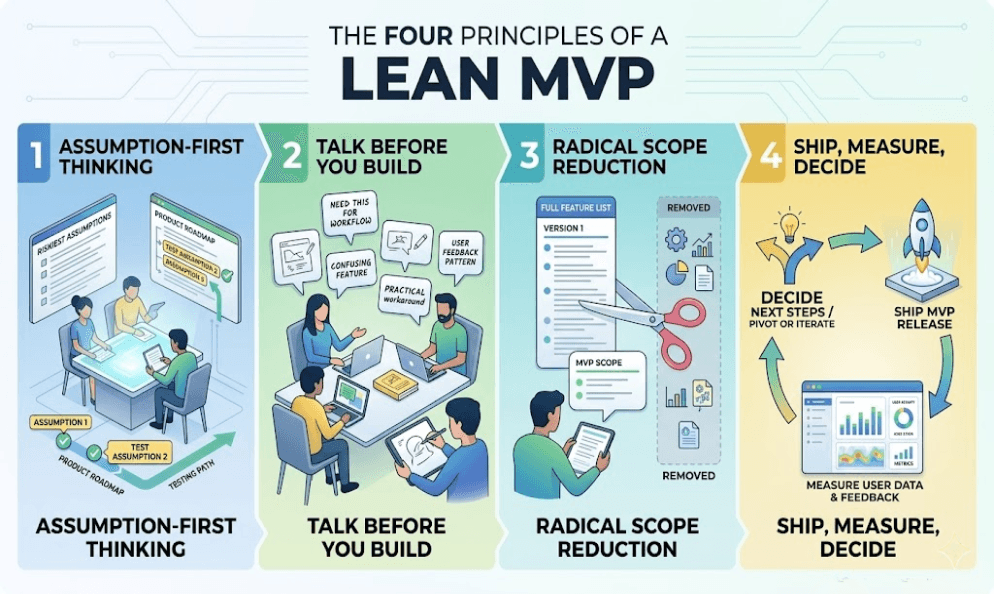
The four principles of a lean MVP
1. Assumption-first thinking
Every product decision rests on assumptions. Name yours explicitly, then rank them by risk. The riskiest assumption gets tested first.
2. Talk before you build
User conversations are the cheapest research tool that exists. Five calls can invalidate weeks of planning. Run them before writing a brief.
3. Radical scope reduction
Take your feature list and cut it in half. Then cut it in half again. Whatever remains is probably still too much for a first release.
4. Ship, measure, decide
Every release is a question, not a statement. Define the metric that answers it before you build, not after you launch.
Lean vs. traditional: what changes
Traditional approach:
1. Build everything, then find users
2. Treat the roadmap as a commitment
3. Measure success by features shipped
4. Learn only after the product is done
5. Protect the original vision at all costs
Lean approach:
1. Find users, then build what they need
2. Treat the roadmap as a hypothesis
3. Measure success by learning generated
4. Learn continuously from day one
5. Pivot when evidence demands it
The 8-week lean MVP sprint
This is the exact timeline we use with non-technical founders at Mediusware.
It's designed to produce a launched, real-user-tested product in two months, without skipping validation.
Weeks 1–2: Map and challenge your assumptions
Write down every assumption your product rests on.
- Who has this problem?
- How often?
- What do they currently do about it?
- What would make them switch?
Rank each assumption by how wrong it could be. The top three get tested immediately.
Output: ranked assumption list.
Weeks 2–3: Run discovery interviews for a minimum of 10
Speak to 10–15 people who represent your target user. Don't pitch. Ask about their current workflow, their frustrations, and what they've tried.
You're listening for patterns, especially unexpected ones. Three common patterns from five separate calls become facts you can build on.
Output: validated problem statement.
Week 3: Define the one core workflow
Based on what you heard, write the single-user flow that delivers your core value. A user opens the product, does X, and gets Y.
That's your MVP scope. Every feature that doesn't appear in this sentence is out of scope for now, no exceptions.
Output: one-sentence MVP scope.
Weeks 3–5: Build with no-code or a targeted freelancer
Now and only now do you start building. Use no-code tools like Bubble, Glide, or Webflow for speed.
If you need custom logic, hire a freelancer for that specific piece only. The goal is a working, testable product, not a polished one.
Output: functional prototype.
Week 5–6: Test with real users before it's ready
Share the prototype with 5–8 of your interview participants.
Watch them use it without guidance.
- Where do they hesitate?
- What do they click first?
- What do they ignore?
These observations are worth more than any survey. Don't fix things during the session, just watch and record.
Output: usability findings.
Weeks 6–7: Iterate on the one thing that matters most
From your usability sessions, identify the single biggest barrier to users getting value.
Fix only that. Resist the urge to fix everything at once; each change should be traceable to a specific learning, so you know what moved the needle.
Output: refined MVP.
Week 8: Launch to a small, targeted audience
Launch to 50–200 people, not the whole world. A niche community, your waitlist, or warm leads from your interviews.
Measure one metric: activation rate, return rate, or payment conversion. Whatever that metric tells you becomes the brief for your next sprint.
Output: real-world learning + sprint 2 brief.

What lean MVP gets wrong in practice
The lean startup framework is widely known and widely misapplied.
Here are the most common misconceptions that cause founders to get the method right on paper and wrong in practice.
1. The myth:
Lean means building something ugly and shipping fast.
But the reality is:
Lean means building the minimum that tests the right assumption. Ugly is irrelevant; incomplete is the problem.
2. The myth:
User interviews replace the need to build anything.
But the reality is:
Interviews identify problems. Only a working product reveals whether your solution actually addresses them.
3. The Myth:
Pivot early and often to stay agile.
But the reality is:
Pivoting too fast is as dangerous as not pivoting at all. You need enough data to distinguish signal from noise before changing direction.
4. The Myth:
An MVP only needs one feature
But the reality is:
An MVP needs only the features required to test your core assumption, which may be one, or may be three. The number isn't the point.
The lean founder's toolkit
1. Typeform
Assumption testing & user surveys.
2. Notion
Interview notes, assumption tracking.
3. Bubble
No-code web app prototyping.
4. Maze
Unmoderated usability testing.
5. PostHog
Product analytics & session replay.
6. Loom
Async user feedback recordings.
Real-world example: From 14-week build to 6-week launch
A founder approached us with a SaaS idea for freelance accountants, a dashboard that consolidated invoices, tax estimates, and client communication in one place.
Her original plan: a full build with all 3 modules, a mobile app, and Stripe integration. Estimated timeline: 14 weeks. Estimated cost: $20,000.
We ran the lean process instead.
- In the first 2 weeks of discovery interviews, a clear pattern emerged: the invoicing and tax modules were genuinely needed, but the client communication feature wasn't. Accountants already had tools for that. They didn't want another one.
- We cut scope to invoicing only, built a Bubble prototype in 3 weeks, and tested it with 6 of her interview participants.
One session revealed that the invoice approval flow, which we'd built in a way that seemed logical, was confusing to every single tester. We redesigned it in two days.
And the result:
- She launched in 6 weeks instead of 14, at $8,400 instead of $20,000.
- Within 1 month, she had 60 paying users and a clear product roadmap built entirely from what those users asked for, not what she originally assumed they'd want.
See our client testimonials about their experience working with Mediusware.
Final Thoughts
By embracing the Lean MVP strategy, you focus on learning first and building only what's necessary to validate key assumptions.
This approach not only saves time and money but also accelerates your path to product-market fit by ensuring you’re meeting real user needs.
Start applying the Lean MVP mindset today and see how it transforms your product development process.
Frequently Asked Questions
When at least 5 people, independently, describe the same problem in the same way and at least 3 of them say they'd pay to solve it. That's not certainty, but it's enough of a signal to justify building a test.

I work with founders and leadership teams when growth moves faster than their systems, teams, or decisions. I’ve led 850+ projects for 750+ clients across 20+ countries, working across 100+ technologies and counting. I care about ownership, clarity, and building things that last beyond the launch.
Featureblogs
Relatedblogs
Authorblogs
01
How to Choose an API Development Company for Your SaaS Product02
Why Software Companies Are Turning to Strategic Partnerships for Faster Growth03
Your SaaS Isn’t Slow Because of Developers It’s a Scaling Problem04
Why Some SaaS Companies Scale Faster Than Others05
AI vs Hiring: When Should SaaS Teams Automate Instead of Hiring?