- Build an MVP to validate your startup idea before overinvesting.
- Focus on core features, launch early, and improve with feedback.
How to Build an MVP: A Guide for Startup Founders
Published on: 8 May 2026
Last updated on: 11 May 2026
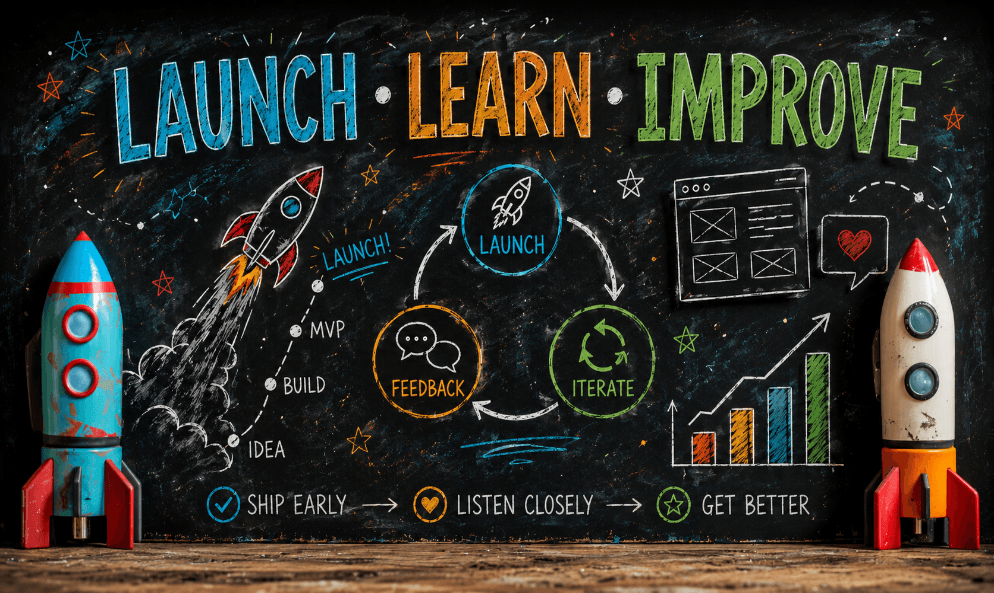
In the fast-moving startup world, speed matters.
But speed does not mean building everything at once.
Many founders spend months developing a full product before knowing whether people actually want it. That is risky, expensive, and often unnecessary.
A Minimum Viable Product helps founders test the core idea quickly with real users, real feedback, and real market behavior.
An MVP is not a cheap or incomplete product.
It is a focused version of your product that includes only the essential features needed to validate your idea.
The goal is simple:
Launch faster, learn earlier, and improve based on real user feedback.
MVP: The Foundation for Startup Growth
An MVP gives startups a practical way to move from idea to market without overcommitting time, money, or resources.
Instead of building a fully featured product from day one, founders can launch a stripped-down version that solves the main problem for their target users.
This helps you answer important questions early:
- Do users understand the product?
- Are they willing to use it?
- Does it solve a real problem?
- What features do they actually need?
- Would they pay for it?
For early-stage founders, these answers are more valuable than assumptions.
You do not need a perfect product to start learning.
You need a usable product that helps validate the core idea.
For a more practical breakdown, you can also read this SaaS MVP checklist before planning your first version.
The MVP Mythbusting
A lot of founders misunderstand what an MVP should be.
They either overbuild it or delay it for too long.
Here are some common MVP myths worth breaking.
Myth 1: You Need to Be a “Jedi” to Build an MVP
Many founders believe they need deep technical knowledge, years of experience, or a perfect product strategy before building an MVP.
That is not always true.
Sometimes, a fresh perspective and willingness to learn can lead to better product decisions.
What matters most is not knowing everything from day one.
What matters is knowing the problem clearly and being open to user feedback.
A good MVP is built around learning.
Not ego.
Myth 2: More Research Always Means Better Decisions
Research is useful.
But endless research can become analysis paralysis.
Some founders spend too much time doing surveys, competitor analysis, and user interviews without ever putting a product in front of real users.
At some point, the best way to learn is to launch.
Real users will show you what they need through their behavior.
They will show you:
- What they click
Where they get stuck
What they ignore
What they ask for
What they are willing to pay for
That feedback is often more honest than survey answers.
Myth 3: Your First MVP Has to Be Perfect
Your first MVP will not be perfect.
And that is okay.
The goal is not perfection.
The goal is validation.
Your MVP should be good enough for users to experience the main value of the product.
After that, you improve based on feedback.
This is how most strong products grow.
They do not launch perfectly.
They launch, learn, and improve.
The MVP Process
Building an MVP does not mean randomly removing features.
It means being intentional about what stays and what waits.
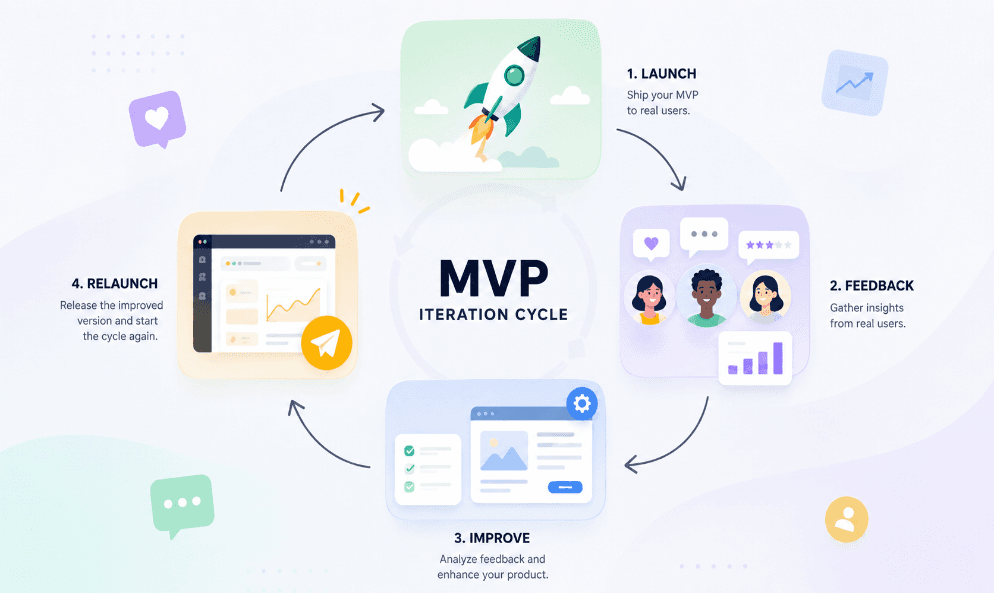
The process should follow the build-measure-learn feedback loop, where you build a focused version, measure real user behavior, and learn what should happen next.
Here is a simple MVP process founders can follow.
Step 1: Define Your Core Value Proposition
Before building anything, clearly define the problem you are solving.
Ask yourself:
- Who is the product for?
- What pain point are they facing?
- Why does this problem matter?
- What solution are we offering?
- What outcome should users get?
For example, “a social media platform” is too broad.
But “a simple platform that helps niche founders build small communities around shared interests” is clearer.
Your MVP needs this clarity.
Without it, your product can quickly become a collection of unrelated features.
Step 2: Build a Minimal Version
Once the core value is clear, identify the essential features only.
Not every idea belongs in the first version.
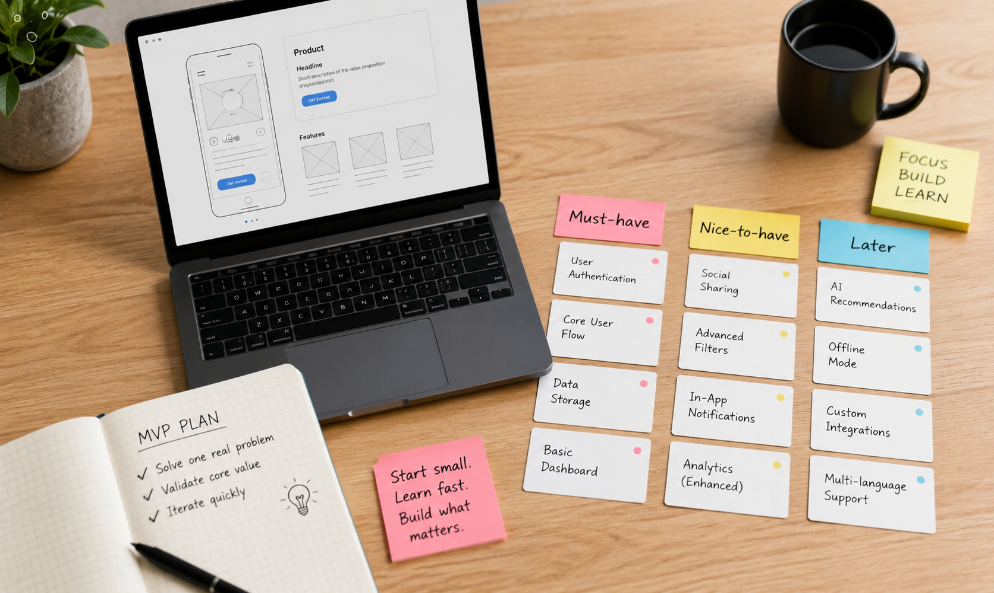
Here is a simple feature prioritization table:
| Feature Type | Meaning | MVP Decision |
| Must-have | Required to deliver the core value | Build now |
| Nice-to-have | Improves experience but not essential | Add later |
| Future feature | Useful after validation | Keep in roadmap |
| Risky feature | Expensive or unproven | Validate first |
| Vanity feature | Looks good but adds little value | Avoid |
For a deeper breakdown, read this SaaS MVP feature prioritization guide.
For example, if you are building a basic social media MVP, you may only need:
- User profiles
- Friend or follow connections
- Simple posting
- News feed
- Basic notifications
You probably do not need advanced AI recommendations, complex analytics, monetization tools, or multiple content formats in version one.
Those can come later.
The MVP should prove the core behavior first.
Step 3: Launch and Gather Feedback
Once the MVP is ready, get it into the hands of potential users.
You do not need a massive launch.
Start small.
You can launch to:
- Beta users
- Your professional network
- Startup communities
- LinkedIn audience
- Niche online groups
- Early waitlist users
The goal is to observe how people use the product.
- Do they understand it?
- Do they complete the main action?
- Do they return?
- Do they ask for improvements?
- Do they recommend it to others?
This stage helps you move from assumption to evidence.
Step 4: Iterate and Improve
Your MVP is only the beginning.
After launch, use real feedback to improve the product.
Look for repeated patterns.
If one person asks for a feature, it may be personal preference.
If many users ask for the same thing, it may be a product signal.
Pay attention to:
- User drop-off points
- Repeated complaints
- Feature requests
- Confusing screens
- Technical issues
- Payment interest
- Usage frequency
Iteration is where the product becomes stronger.
The first version helps you learn.
The next versions help you grow.
Real-World MVP Examples
Some of the world’s most successful companies started with simple MVPs.
1. Airbnb
Airbnb started with a basic idea: renting out airbeds during conferences.
It was not a global accommodation platform at the beginning.
The founders tested a small version of the idea, proved demand, and expanded from there.
2. Twitch
Twitch began with a narrower streaming concept before becoming one of the biggest live-streaming platforms for gamers.
Its growth came through user behavior, community adoption, and continuous iteration.
3. Stripe
Stripe started by solving one painful problem: making online payments easier for developers.
It did not begin as the full financial infrastructure platform it is today.
It focused on one core problem first.
The lesson is simple:
Great products often start small.
Overcoming MVP Fears
Many founders delay their MVP because of fear.
That fear is normal.
But it should not stop progress.
Fear of Failure
Negative feedback can feel uncomfortable.
But feedback is not failure.
It is data.
If users do not respond the way you expected, that gives you a chance to adjust before spending more money.
A failed assumption is much cheaper than a failed full product.
The Fake Steve Jobs Mindset
Some founders believe they already know exactly what users want.
That mindset is dangerous.
Great products often come from experimentation, not certainty.
You may have a strong vision, but users will help shape the product into something more useful.
An MVP keeps you close to the market.
That is where better decisions happen.
The Power of MVPs: A Simple Case Example
Imagine you have an idea for a new social media platform.
Instead of spending years building a complete app with messaging, groups, video, ads, creator tools, and advanced recommendations, you start with the basics.
Your MVP includes:
- User profiles
- Friend connections
- Simple posting
- News feed
- Basic engagement
With this version, you can test whether people actually want the core experience.
- Do they create profiles?
- Do they connect with others?
- Do they post content?
- Do they return?
- Do they invite friends?
If the answer is yes, you can build the next layer.
If the answer is no, you can adjust the product before spending more.
That is the power of an MVP.
It protects you from building too much too soon.
When Should You Work With an MVP Development Team?
Some founders can test very early ideas with no-code tools or simple prototypes.
But custom development becomes important when the product needs:
- User accounts
- Payment systems
- Dashboards
- Admin panels
- Custom workflows
- Third-party integrations
- Data security
- Scalable architecture
- Mobile or web app development
This is where working with an experienced MVP development team helps. A strong MVP development team does not just build features.
They help you decide what should be built first, what should wait, and what needs to be validated before investing more.
Let’s Build Your MVP Together
Building an MVP is not about creating a perfect product from the start.
It is about validating your idea, gathering real feedback, and improving quickly.
If you are an early-stage founder, the most important thing is not to build everything.
It is to build the right first version.
At Mediusware, we help founders turn ideas into practical, scalable MVPs that are ready for real-world validation. Whether you need, we can help you move from idea to launch with clarity.
Frequently Asked Questions
An MVP is a stripped-down version of your product that helps you test your core idea in the market quickly.
It is important because it helps startups validate demand, reduce risk, gather feedback, and avoid spending too much time or money before knowing what users actually want.

I work with founders and leadership teams when growth moves faster than their systems, teams, or decisions. I’ve led 850+ projects for 750+ clients across 20+ countries, working across 100+ technologies and counting. I care about ownership, clarity, and building things that last beyond the launch.
Featureblogs
Relatedblogs
Authorblogs
01
How to Choose an API Development Company for Your SaaS Product02
Why Software Companies Are Turning to Strategic Partnerships for Faster Growth03
Your SaaS Isn’t Slow Because of Developers It’s a Scaling Problem04
Why Some SaaS Companies Scale Faster Than Others05
AI vs Hiring: When Should SaaS Teams Automate Instead of Hiring?